Your Grandfather Bought Shares in 1987. They're Still Yours. Here's How to Get Them Back.
Let me start with a story.
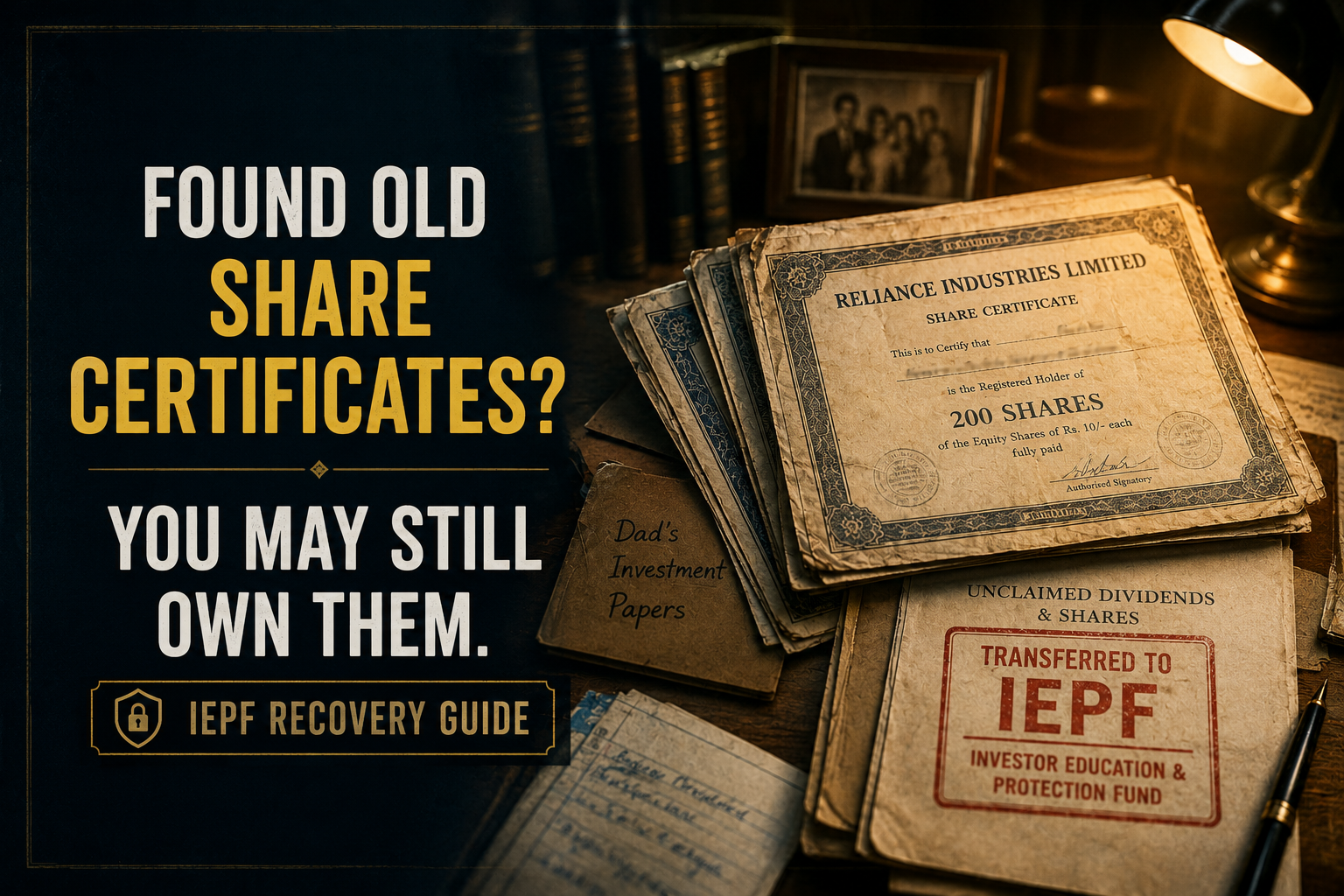
A family in Pune is going through old paperwork after their father passes away. Between electricity bills and school certificates, they find a crumpled share certificate — Reliance Industries, 200 shares, bought sometime in the early 90s. Nobody even knew it existed.
Turns out those shares — after splits, bonuses, and decades of growth — are worth a few lakhs today.
But there's a catch. The dividends were never claimed. For years and years. And because of that, both the unclaimed dividends and the shares themselves got transferred to something called the IEPF.
This is where most people give up. Don't.
What Even Is IEPF?
IEPF stands for Investor Education and Protection Fund. It's a government body under the Ministry of Corporate Affairs — basically a giant holding account where companies are legally required to transfer unclaimed dividends after 7 consecutive years of non-collection.
Here's the part that trips people up.
It's not just the dividends. If dividends on your shares go unclaimed for 7 years straight, the shares themselves get transferred to IEPF. Your shares. Still yours legally — but now sitting with the government until you come claim them.
The good news? You absolutely can claim them back. The process is annoying, yes. Impossible? Not even close.
How Do Shares End Up There in the First Place?
A few very common reasons:
Address changed, company didn't know. Dividend warrants kept bouncing back. After 7 years — off to IEPF they go.
Inherited shares nobody knew about. Parents or grandparents bought shares decades ago. Nobody updated the records. Dividends piled up unclaimed.
Old physical share certificates. Pre-demat era shares that were never converted. Still valid. Still yours. But completely off the radar.
NRI shareholders. Moved abroad, lost track of Indian investments. Classic.
Simply forgot. Someone bought shares in a company that got merged, renamed, or restructured. Lost track. Dividends went uncollected.
None of these situations are permanent. Every single one can be fixed.
The Recovery Process — Let's Actually Walk Through It
This is where I'll be straight with you: the process has multiple steps and requires patience. But it's structured. Follow it, and it works.
Step 1: Check If Your Shares Are Actually with IEPF
Go to iepf.gov.in → click on "IEPF-5 Claimant Search" or check the MCA portal. You can search by company name, shareholder name, or folio number.
If your shares show up there — great, now you know what you're dealing with.
Step 2: File Form IEPF-5
This is the official claim form. You file it online at the MCA portal (mca.gov.in). One form per company whose shares you're claiming.
You'll need to fill in details like your Aadhaar and PAN, demat account details (IEPF transfers shares back in demat form), bank account details for dividend refund, and folio number / DP ID.
Take your time here. Errors cause rejections. Double-check everything.
Step 3: Send Physical Documents to the Company's Nodal Officer
After filing online, you need to send a physical copy of the form along with supporting documents to the company's registered office. Each company has a designated Nodal Officer for IEPF claims.
Documents typically required: original share certificates (if physical), copy of Form IEPF-5 with SRN, indemnity bond on stamp paper, advance receipt on stamp paper, copy of Aadhaar, PAN, passport-size photos, cancelled cheque, and transmission documents if you're a legal heir — death certificate, legal heir certificate, will or succession certificate.
The heir situation adds a layer of complexity, but it's very doable.
Step 4: Company Verifies, Then MCA Processes
The company's Nodal Officer verifies your documents and forwards their recommendation to the IEPF Authority. The authority then processes the claim and transfers shares back to your demat account and dividends to your bank.
Timeline? Officially 60 days after the company submits. In reality — budget 3 to 6 months. Sometimes longer if documents go back and forth.
The Heir Situation — When You're Claiming on Behalf of Someone Who's Passed
This deserves its own section because it's where most families get stuck.
If the original shareholder has passed away, you need to establish your legal right to claim. That means a death certificate of the original holder, a legal heir certificate issued by a court or revenue authority, or a succession certificate — especially if the amount is significant and there are multiple claimants — and a notarized indemnity bond signed by all legal heirs.
The succession certificate part can take time through the courts — sometimes months. But once you have it, the actual IEPF claim process moves forward normally.
One thing people often skip: if the shares are jointly held and the first holder has passed, the second holder can claim directly without going through the full legal heir route. Check your share certificate carefully.
Common Mistakes That Delay Everything
Mismatch in name or signature. Your PAN says "Ramesh Kumar" but the share certificate says "R. Kumar." This will cause issues. Get it rectified first through the company's RTA.
Wrong demat account details. The shares come back to demat, not physical. If your demat details are wrong or you don't have one — open one before filing.
Not sending physical documents. A lot of people file the online form and think they're done. You're not done until the physical documents reach the company's Nodal Officer with an acknowledgment.
Filing for multiple companies in one form. One IEPF-5 per company. That's the rule.
Ignoring RTAs. For many issues — name correction, address update, signature mismatch — you deal with the company's RTA like KFin Technologies or Link Intime, not directly with IEPF. Know who handles what.
Is It Worth the Effort?
Almost always, yes.
People have recovered shares worth lakhs — sometimes crores — through this process. Shares bought for ₹10 each in the 80s that have split multiple times, issued bonuses, and compounded quietly for 30+ years.
The paperwork feels tedious. The timeline tests your patience. But the money is legally yours — the government isn't keeping it, they're holding it until you show up and claim it.
Show up.
One Last Thing
If this feels overwhelming — or if the original documents are damaged, the company has merged with another entity, or you're dealing with a complicated inheritance situation — professional help is worth it. There are CA firms and specialized consultants who handle IEPF claims regularly. They know the shortcuts, they know which RTAs are slow, and they know how to write the covering letters that actually get processed quickly.
Sometimes paying someone ₹5,000–₹15,000 to recover ₹3 lakh in shares is just... smart math.
But if you're the kind of person who enjoys following a process step by step? Do it yourself. The MCA portal is functional, iepf.gov.in has FAQs, and the IEPF Authority does have a helpline: 1800-11-4949.
Your shares are waiting. They've been waiting for years.
Go get them.
Dealing with a specific IEPF situation — lost certificates, heir claims, name mismatch? Drop your question below and let's figure it out together.