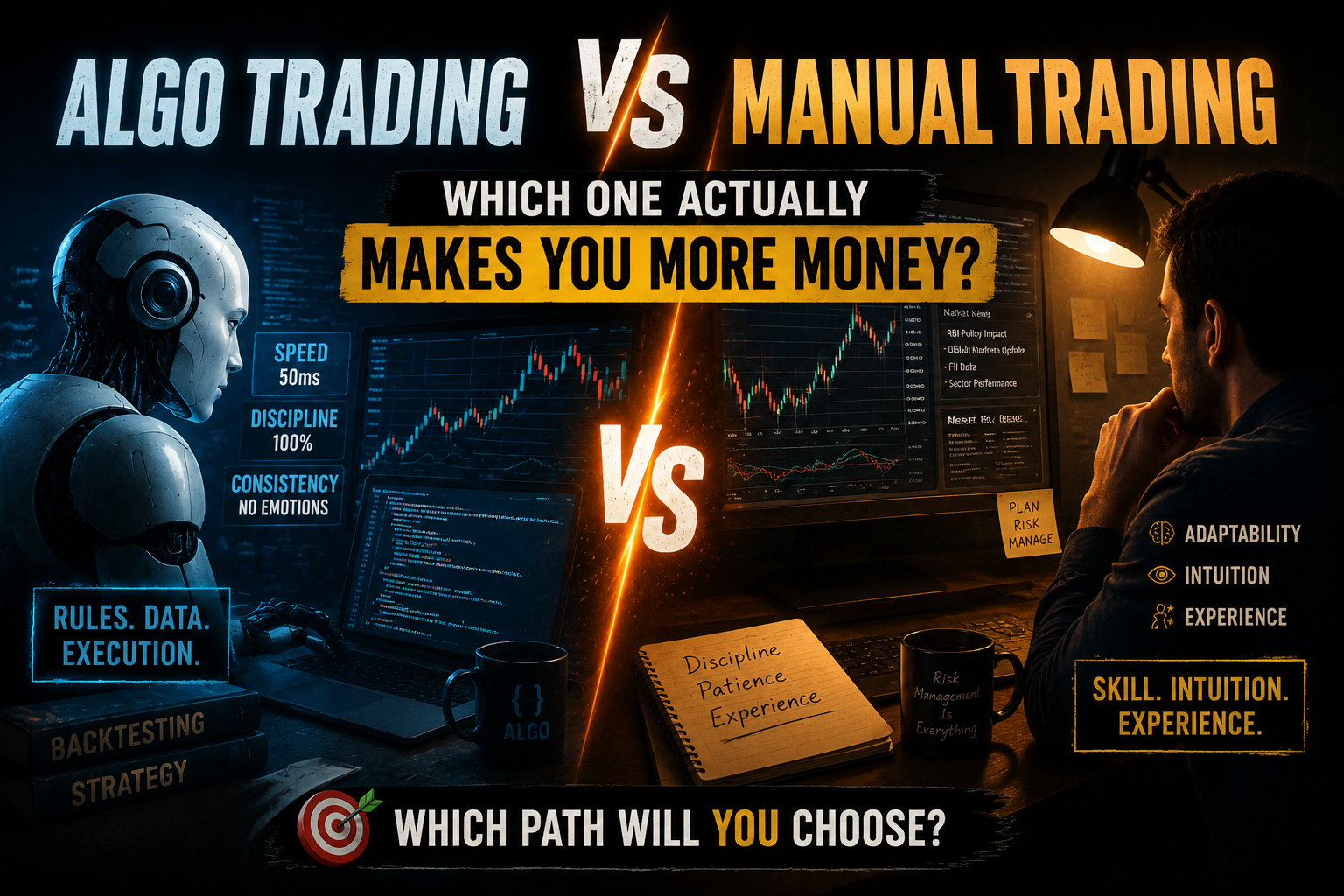
Algo Trading vs Manual Trading: Which One Actually Makes You More Money?
Let me settle this debate once and for all.
Actually — I can't. Nobody can. But I can give you the most honest comparison you'll find, without the usual "it depends on your goals" nonsense that tells you absolutely nothing.
Let's get into it.
First, Let's Be Clear About What We're Comparing
Manual trading — you sit in front of a screen, you watch charts, you read news, you feel something, and you press buy or sell. Every decision goes through your brain first.
Algo trading — you write rules, the computer follows them. You're not in the loop when the trade happens. The machine decides, based on what you programmed.
Same markets. Same stocks. Completely different approach.
Round 1: Speed
Manual trader sees a breakout forming. Brain processes it. Hand moves to mouse. Click. Order placed.
Time taken? Maybe 2–5 seconds on a good day.
An algo spots the same breakout. Order fires. Done.
Time taken? 50 milliseconds. Sometimes less.
In volatile markets — especially in Bank Nifty options where prices move 50 points in seconds — that difference isn't small. It's everything.
Winner: Algo. No contest.
Round 2: Emotions
This one hurts to admit if you're a manual trader.
You've been there. A trade goes against you by 2%. You tell yourself "it'll bounce back." It doesn't. Now you're down 6% and still holding because your ego won't let you book the loss.
Or the opposite — you exit a winning trade way too early because you're scared of giving back profits. The stock then runs another 15%.
Algos don't have ego. They don't have fear. They don't check their P&L every 10 minutes and make decisions based on how stressed they feel.
The rule says exit at 3% stop-loss — it exits. Every single time. No negotiation.
Winner: Algo. Emotions are a trader's worst enemy.
Round 3: Consistency
A manual trader on Monday after a good weekend? Sharp, focused, executing well.
Same trader on Thursday after three consecutive losing days? Second-guessing every entry, skipping valid setups, revenge trading.
Humans are inconsistent by nature. Our performance fluctuates with sleep, mood, personal stress, and a hundred other things that have nothing to do with the market.
An algo has no bad days. It executes trade number 847 exactly the same way it executed trade number 1.
Winner: Algo again.
Round 4: Adaptability
Here's where manual traders fight back — and they're right to.
Markets change. Regimes shift. What worked in a trending market completely breaks down in a sideways, choppy one. An algo coded for trending conditions will bleed money when the market goes into consolidation — and it'll keep bleeding until you manually intervene and turn it off.
A experienced manual trader? They feel the market changing. They slow down. They shift their approach. They skip setups that don't feel right.
That intuition — built over years of screen time — is genuinely powerful. It can't be coded. Not easily, anyway.
Winner: Manual Trading. Humans adapt. Algos need to be told to.
Round 5: Backtesting and Validation
Before a manual trader "knows" a strategy works, they need months — sometimes years — of live trading to build any statistical confidence.
An algo trader can test the same strategy on 10 years of historical data in 20 minutes. See exactly how it performed across bull markets, bear markets, sideways markets, black swan events. Know the win rate, drawdown, risk-reward ratio — all before risking a single rupee live.
That's an insane advantage.
Winner: Algo. Data beats gut feel for validation.
Round 6: Capital Requirements
Here's something nobody talks about enough.
To make meaningful returns from algo trading — especially HFT or arbitrage — you often need significant capital. Transaction costs, slippage, brokerage, STT — these eat into thin margins fast. A strategy that works beautifully on paper with ₹10 lakh might barely break even after real costs.
Manual trading? You can start smaller, be selective, take only your highest conviction trades, and still do well. A sharp manual trader taking 3–4 trades a week doesn't need to overcome the same cost burden.
Winner: Manual Trading. Lower barrier to entry.
Round 7: Time Commitment
Manual trading demands your presence. You have to watch the screen. Miss a setup — it's gone. Market opens at 9:15, you better be there.
Algo trading, once set up properly, runs on its own. You can have a full-time job and still run a trading strategy in the background. The machine doesn't need you to babysit it.
But — and this is important — building and maintaining algos takes serious time upfront. Coding, backtesting, paper trading, debugging, optimizing. That's not passive. That's a project.
Winner: Algo for long-term time freedom. Manual for simplicity upfront.
The Honest Scorecard
Algo wins: Speed, Emotion Control, Consistency, Backtesting, Time Freedom
Manual wins: Adaptability, Lower Capital Barrier, Simplicity
Looking at that, you'd think algo trading is clearly superior. And in many ways — at scale, with proper capital and coding skills — it is.
But here's the thing most algo trading courses won't tell you.
Most retail algo strategies fail within 6–12 months. Markets evolve, edges disappear, and the strategy that looked incredible in backtesting slowly bleeds in live conditions. Maintaining a profitable algo requires constant monitoring, tweaking, and sometimes starting from scratch.
Meanwhile, a disciplined manual trader with a solid system — proper risk management, defined setups, emotional control — can trade profitably for decades without writing a single line of code.
So Who Should Do What?
Go algo if — you can code or are willing to learn, you have enough capital to absorb transaction costs meaningfully, you're analytical and love data, and you want to eventually step away from the screen.
Stick to manual if — you're just starting out, you want to deeply understand markets before automating anything, your capital is limited, or you genuinely enjoy the process of active trading.
The smartest move? Both.
Seriously. Use manual trading to develop your edge and understand what actually works. Then automate the strategies you've already proven work manually. That's how the best traders operate — they don't pick a side, they use both tools for what they're each good at.
Final Thought
The question isn't really "which is better." The question is — what stage are you at, what resources do you have, and what kind of trader do you want to become?
Algo trading is a tool. Manual trading is a skill. The best traders in the game — the ones actually making consistent money — treat them that way.
Use the right tool for the right job.
That's it.