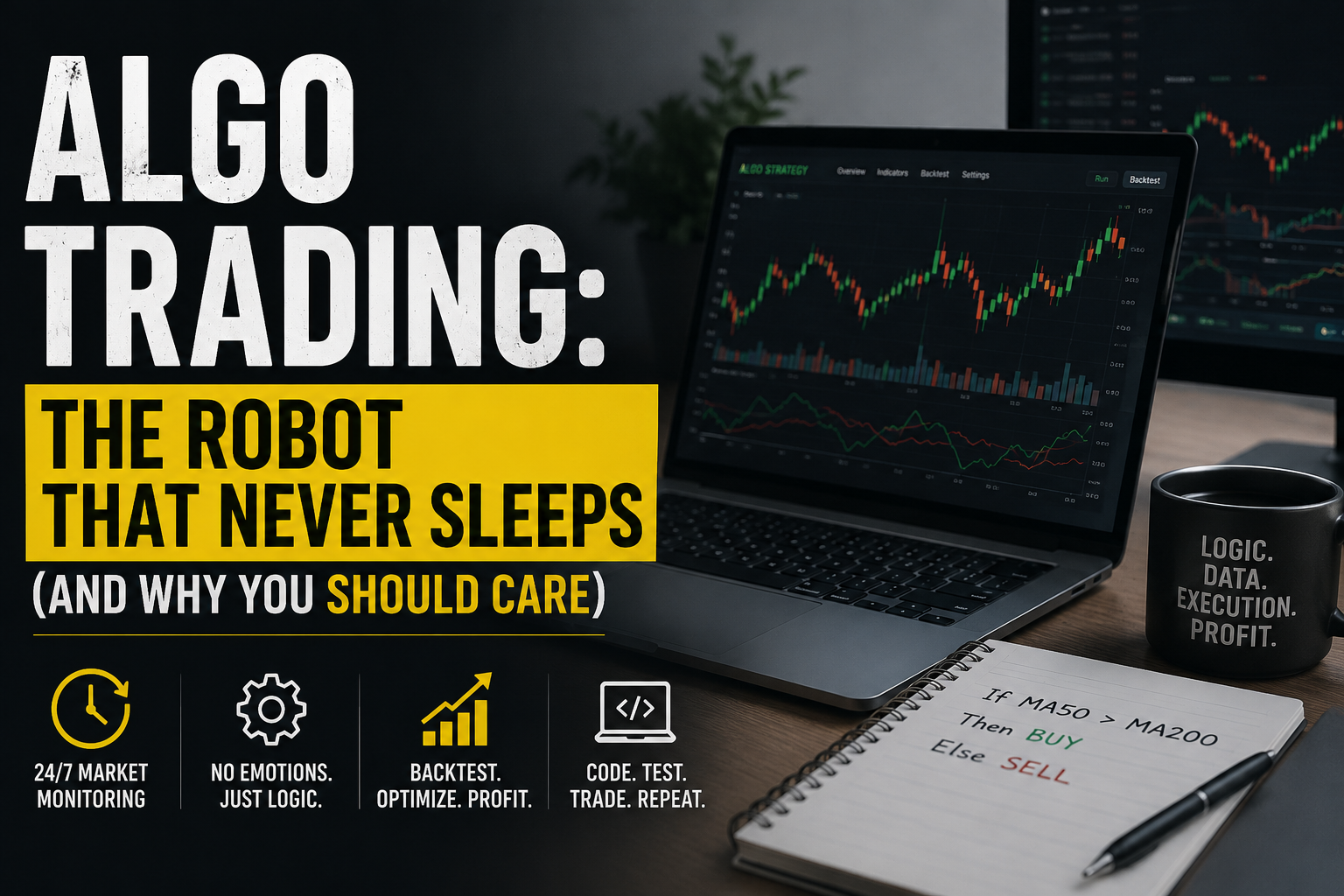
Algo Trading: The Robot That Never Sleeps (And Why You Should Care)
Let me be real with you for a second.
When I first heard the term "algorithmic trading," I pictured some genius in a dark room, surrounded by screens, sipping coffee at 3 AM while millions of dollars moved around on their own. Turns out? That picture isn't entirely wrong.
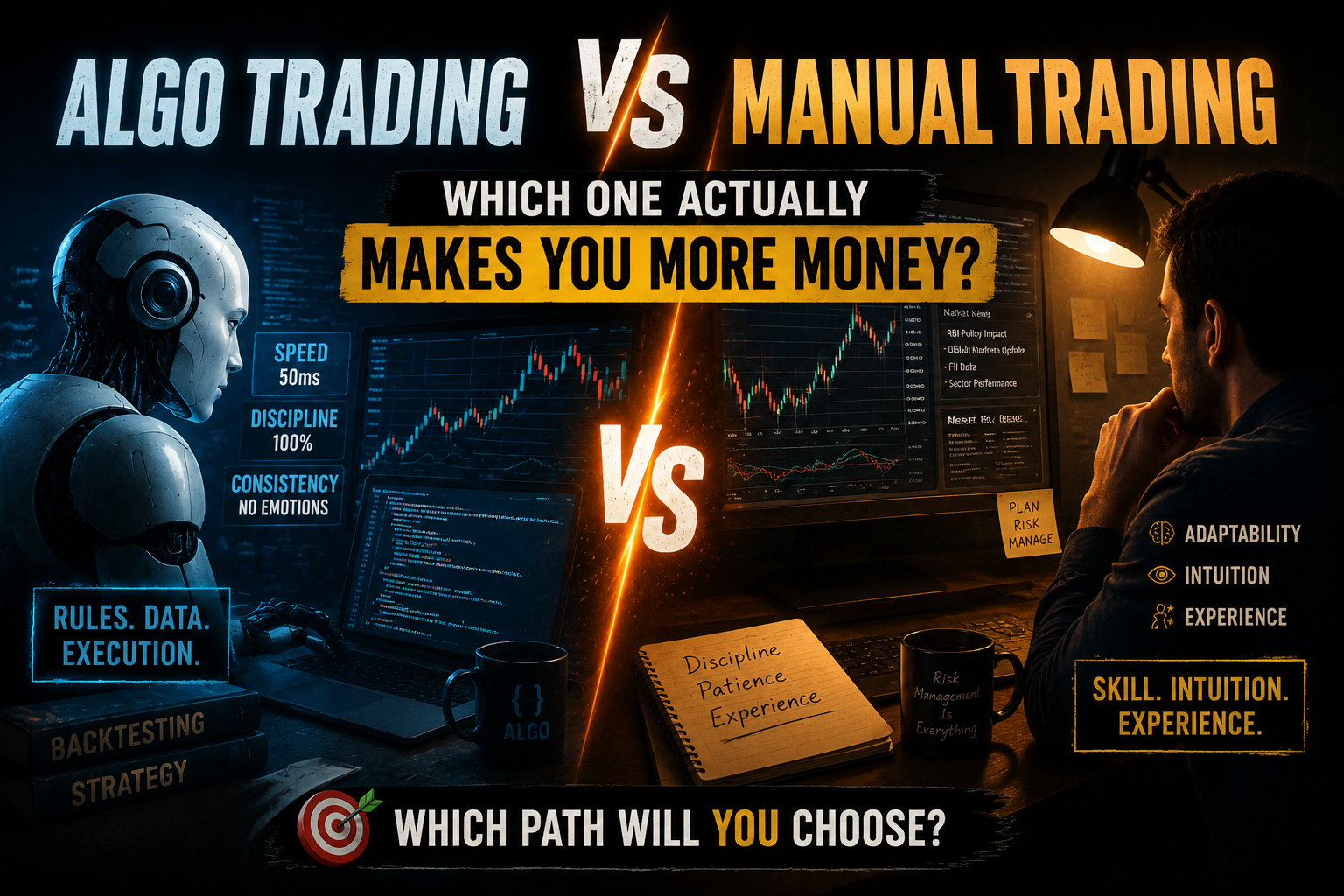
Algo trading — short for algorithmic trading — is basically teaching a computer to buy and sell stocks (or crypto, or forex, or whatever you fancy) based on a set of rules YOU define. No emotions. No panic. No "oh crap, should I sell?!" at 2 AM. The machine just... does the thing.
Okay But What Even Is It?
Think of it like this.
You know how you set rules for yourself? "If it rains, I'll take an umbrella." Simple. Algo trading works the same way — except the rules sound more like: "If the 50-day moving average crosses above the 200-day moving average, buy 100 shares of this stock."
The algorithm watches the market 24/7, spots that condition, and executes the trade — faster than any human ever could. We're talking milliseconds. Sometimes microseconds.
You blink. The trade is done. Multiple times.
Why Do People Love It So Much?
A few reasons, and they're pretty solid ones.
Speed. No human can react as fast as a computer. By the time your brain processes "the price dropped," the algo has already bought the dip, set a stop-loss, and is halfway through its next calculation.
No Emotions. This is the big one. Every trader will tell you — emotions kill portfolios. Fear makes you hold a losing trade too long. Greed makes you exit a winner too early. An algorithm? It doesn't care. It follows the rules. Period.
Backtesting. Before you risk a single rupee, you can test your strategy on years of historical data. Did your idea work in 2018? In the COVID crash of 2020? You'll know before you ever go live.
Consistency. It executes the same way every single time. No bad days. No "I didn't sleep well" decisions.
The Strategies — Where It Gets Fun
This is honestly the most interesting part.
There are dozens of strategies people use, but here are the big ones you'll hear about constantly:
Trend Following — The simplest one. If a stock is going up, buy it. If it's going down, sell it. Ride the wave until the wave dies. Sounds obvious, but it's surprisingly effective when coded well.
Mean Reversion — The opposite idea. Prices tend to snap back to their "average" after extreme moves. So if something drops way too hard, you bet it'll bounce back. Like a rubber band.
Arbitrage — This one's sneaky and brilliant. The same asset sometimes trades at slightly different prices on different exchanges at the same moment. Algos spot this gap and exploit it before it closes. Profit from inefficiency. Simple as that.
Market Making — You place both buy and sell orders simultaneously, earning the tiny spread between them. Do that millions of times? The tiny adds up to massive.
High-Frequency Trading (HFT) — The extreme version. Thousands of trades per second. This is what big hedge funds and proprietary trading firms do. Requires serious infrastructure. Not your weekend project.
Can YOU Do It?
Honest answer? Yes. But with a big "it depends."
If you can code — even basic Python — you can build simple algo strategies. Platforms like Zerodha's Kite Connect, Interactive Brokers, or Alpaca give you API access to real markets. Libraries like pandas, TA-Lib, and Backtrader make backtesting surprisingly accessible.
The real barrier isn't technical. It's intellectual.
Building an algo is easy. Building a profitable algo? That takes time, testing, failing, testing again, and more failing. Most retail algos don't beat a simple buy-and-hold strategy. That's just the truth.
But here's the thing — you learn insane amounts about markets, statistics, and your own risk tolerance in the process. That's worth something even if your first strategy flops.
The Dark Side (Yeah, There Is One)
Algo trading isn't all glory. A few things that can go wrong:
Overfitting. You tweak your strategy so perfectly for past data that it becomes useless in live markets. Your algo "learned" the past, not the future.
Flash Crashes. Remember May 6, 2010? Algorithms gone haywire wiped nearly $1 trillion from US markets in minutes. Then recovered. Chaos. Pure chaos.
Costs. Brokerage fees, data feeds, server costs — these eat into profits fast, especially at lower capital.
Market Changes. A strategy that crushed it in 2019 might be completely dead by 2023. Markets evolve. Your algo needs to evolve too.
So... Should You Get Into It?
If you love markets AND you love logic/coding — absolutely yes. Start small. Paper trade first (fake money, real conditions). Learn Python if you haven't. Read about basic technical indicators. Then build something tiny, test it to death, and see what happens.
If you're looking for a "set it and forget it" money machine — pump the brakes. That's not what this is.
Algo trading rewards curiosity, patience, and people who genuinely enjoy the process of problem-solving. The money — if it comes — is almost a byproduct.
The real reward? Watching your logic, your rules, your thinking — play out in live markets while you sleep.
That's a different kind of cool.
Got questions about building your first algo or where to start? Drop them below — happy to nerd out about this stuff.